
Inside Flyover Film Studios, where five filmmakers turned a shuttered Illinois Air Force base into central Illinois’ bid to be the “Hollywood of the Midwest”
By Jeff Gayduk, Destination Film Guide
I’m driving in circles around a low brick building that could pass for a suburban office park, through this stretch of central Illinois most people only ever see from the window seat of a puddle-jumper into Willard Airport. Apple Maps says I’m here, but this looks nothing like a film studio. It never quite does, not in the way I expect. Thankfully, Robert Patrick Stern, one of the principals from Flyover Studios, guides me into a parking lot and tells me this is where it starts.
“This building, in general, the gist of it is you’d have a studio lot in California,” he says, walking me through the front doors. “A lot of groups would be like, ‘I’m Paramount, but I have an office at Warner Brothers. I’m Netflix, and I have an office at Paramount.’ This building is here for that.”
Inside, the hallways are decorated the way you’d expect a studio to look and nothing like the way you’d expect from a former Air Force building: neon signage, an arcade cabinet, a pool table, a wall of framed movie posters for productions that shot here. Down another hall, a plain office sits ready and waiting, empty except for a desk, a monitor, and a window looking out over the old runway. Stern doesn’t dwell on the contrast, but I do. Until recently, this was just another vacant building at Chanute Air Force Base, one of hundreds the Village of Rantoul inherited when the base announced its closure in 1993 and didn’t know what to do with. Today it’s a production office, and by Monday it’ll be bustling with a film crew.
That’s the whole idea, Stern tells me, as we walk. “Starting mid-flight. A production lands here and doesn’t start from zero.”
Built for filmmakers. Backed by destinations. Download the Destination Film Guide magazine—free.
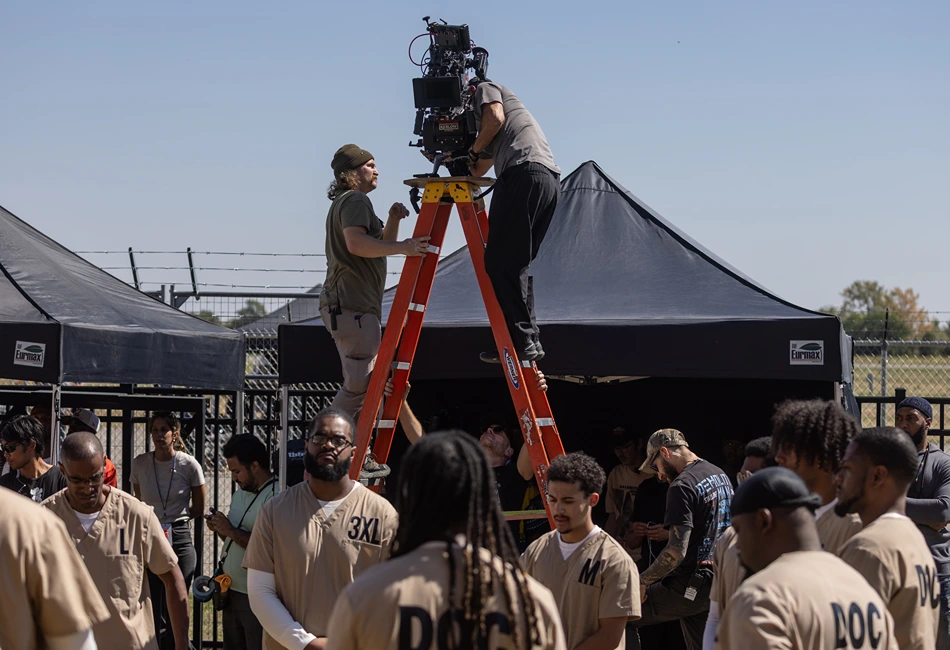
Moses the Black yard shot
The Town the Air Force Left Behind
To understand why that phrase matters, you have to understand what this town lost.
Chanute Field was established in 1917, and for most of the twentieth century it WAS Rantoul. Generations of airmen trained here; the base dominated the local economy through two world wars and the Cold War that followed. Then, in 1993, the Department of Defense decided to close it, leaving Rantoul with an enormous footprint of Air Force infrastructure and nowhere near enough population or tax base to use it.
“The closing of the base was devastating to Rantoul,” Mayor Samuel E. Hall III told me. “It created an immediate decline in population, which in turn caused vacant housing across the community, large-scale buildings to either be demolished or repurposed, and a significant loss in expendable income, which had a horribly negative impact on tax revenue for the Village.”
What followed was three decades that most small towns never fully climb out of: stores and restaurants closing, structures deteriorating, base buildings crumbling faster than anyone could repurpose them, more infrastructure standing than the town had people to fill it.
“The community fell stagnant,” Hall said. “Little growth occurred, population dwindled, and most notably, residents began to lose pride in their town.”
Today, Rantoul is a village of just over 12,000 people with a median household income under $50,000. According to the Census Bureau’s own estimate, nearly one in five residents live below the poverty line. Those numbers are the reason everything that’s happened at Chanute Field in the last three years reads less like a real estate story and more like a second chance.
Inside Flyover Film Studios
Filmmakers Who Saw a Location, not a Liability
Developers didn’t build Flyover Film Studios; it was built by five filmmakers — Robert Stern, Sarah Sharp, Jen Shelby, Brett Hays, and Dustin Hoke — who backed into Rantoul almost by accident, through a sister production company already working in nearby Champaign, and a pandemic that forced the industry to get creative.
“We approached stepping onto the Air Force base the same way we, as film workers, step into a location; how does it fit our story?” said co-founder Sarah Sharp. “A dingy basement, a Victorian home, an open meadow — these are all beautiful and perfect for each of their stories, and a massive Air Force hangar is the star of ours.”
“It is truly a giant sandbox where we are only limited by the height of our ceilings,” said co-founder Dustin Hoke, “and they are remarkably tall. From the second we stepped inside, we knew the potential for filmmaking in such a large structure.”
Stern walked me through how it actually happened: a COVID-era test production, built to prove that a small crew could shoot safely under pandemic restrictions, that ended up helping inform protocols for productions racing to finish out their seasons. What began as a favor for industry friends turned into a standing relationship with the village. Flyover built out a stage in one of the base’s cavernous hangars for a single film.
Then the Village asked if they’d consider staying.
“When they came before the Board, it wasn’t just a discussion about how they can rent and eventually purchase a hangar,” Mayor Hall said, “but rather a vision for how they can change the future direction of the Village through the motion picture and television industry. From day one, they talked about investing in properties to make them suitable for TV and film; investing in partnerships with other businesses in the community for food, lodging, set and prop making, costuming; investing in the people of Central Illinois when casting and training crew… The Board came to vote on a lease agreement and left with an exciting vision for how Flyover can change the entire trajectory of this community.”
It wasn’t built on outside capital, either. “We made the decision early on to grow this in a more organic fashion, rather than go out and get a loan for the millions it would take to complete our vision in a facility this size,” co-founder Jen Shelby told me. “We have investors that have come on board via purchase of shares and via sweat equity, and we have reinvested every dime we have made so far. We are well over a million dollars into this project when you take all of that into account and we will continue to build this out in the same manner.”
Shelby was candid, too, about how close she came to walking away before it started. “For me personally it was my age, and the daunting task of launching this huge project,” she said. “I walked into the hangar and saw a money pit, but I also saw and understood the vision of my partners. I am glad I agreed to jump in the deep end with the rest of them.”
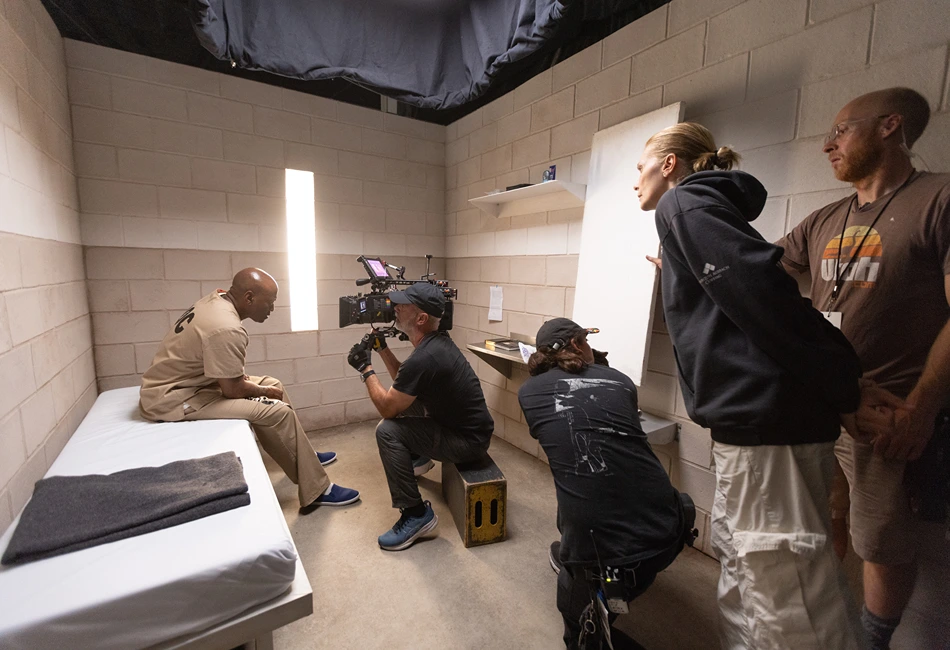
Moses the black prison cell
Not Starting from Zero
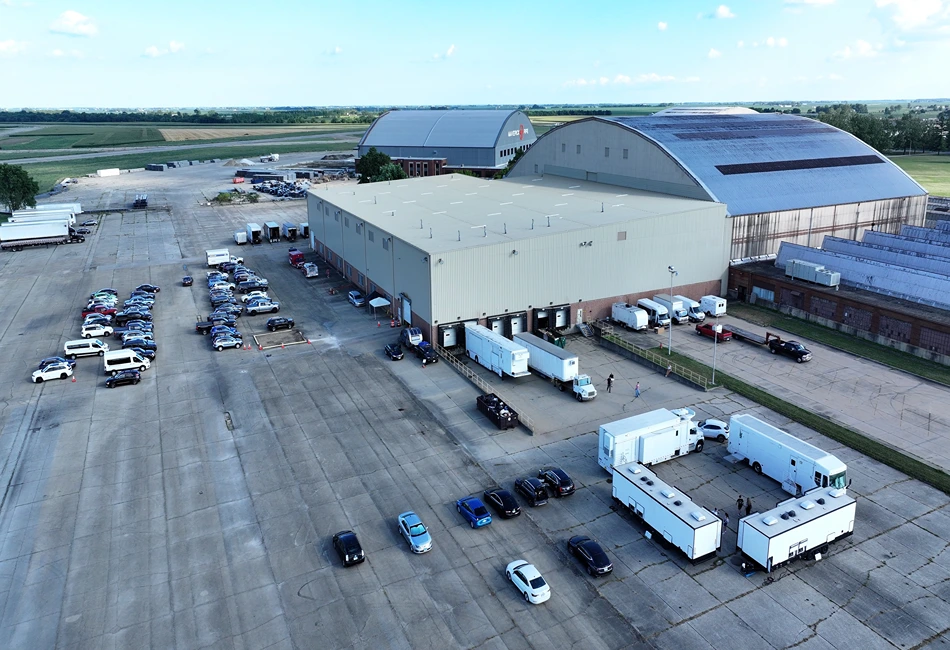
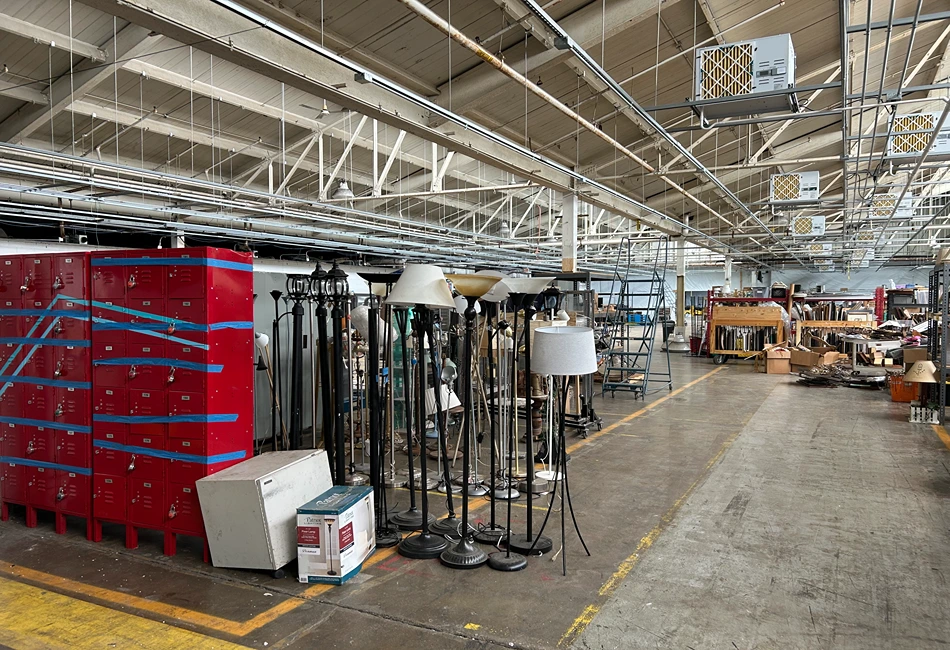
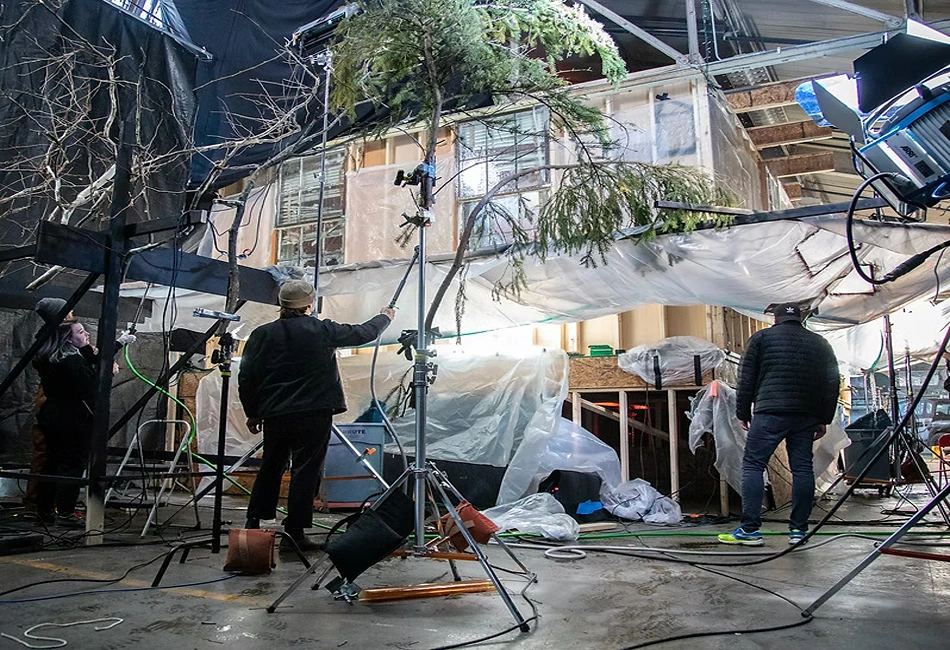
What Flyover built in three years is hard to reconcile with a town most people wrote off in the 1990s. The studio now occupies roughly seven acres across the old base throughout several hangars and buildings, anchored by two soundstages at 52,000 square feet each, with 41-foot ceilings and concrete floors built to hold Air Force cargo, not soft-lit sets.
Forty-five thousand square feet of production offices, spread across three buildings, come fully wired with gigabit internet, video surveillance, kitchens, and washers and dryers so that a visiting crew can set up a functioning production office in hours instead of weeks.
You’ll also find multiple production trailers, RVs for cast and crew, plus a fleet of Crown Vics, ready for their next 1970s-era chase scene.
More impressive: a ten-thousand-square-foot wardrobe department holds more than 40,000 garments, hundreds of pairs of shoes, and thousands of accessories, much of it absorbed from productions that wrapped in Chicago and would otherwise have headed to a landfill. I had my eyes on a Chicago Police Department jacket, a recent arrival from The Bear, but Stern insisted its next life be part of an upcoming film, not my coat closet.
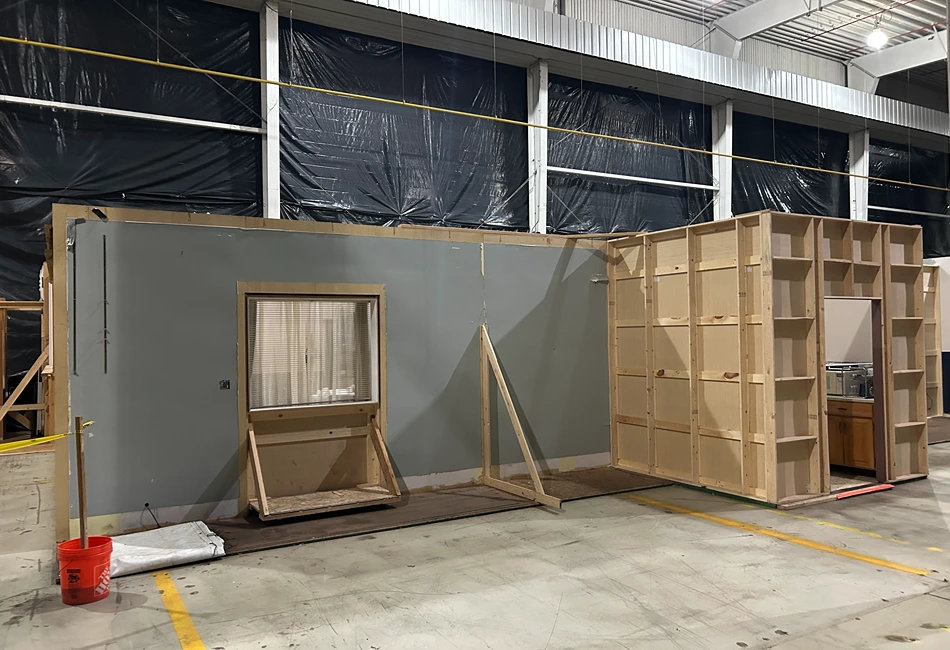
Stern walked me past a collection of standing sets built into one of the stages, including a prison cell, a 1950s-era living room, and a bedroom dressed down to the framed photos on the dresser. All these stay up between productions rather than getting struck and rebuilt from scratch every time. It’s part practicality, part philosophy. Rather than build, tear down, and discard, Flyover leaves what it can standing and lets the next production adapt it. That ethos happens to line up neatly with Illinois’ newest film incentive, which now offers an additional 5% tax credit for productions that earn “green” certification. But at Flyover, recycling came first, and the incentive caught up.
That incentive stack is a big part of why productions are looking closer to central Illinois. Illinois’ film tax credit, expanded under legislation Governor JB Pritzker signed in December 2025, now offers a base credit of 35% on qualified in-state spending, up from 30%, plus an additional 5% for Illinois labor on productions filming outside Chicago’s collar counties. This bonus was written specifically to help towns like Rantoul compete.
Co-founder Brett Hays sees it compounding further: “Looking ahead to five years into the future, our goal is to operate at least four sound stages,” he told me. “We anticipate that television production will emerge as a considerable client, particularly as shows currently in production consider relocating to capitalize on enhanced incentives. Productions that choose to relocate an existing television series will receive an additional 5%, which would position us as one of the most competitive incentives in the world.”
For Hoke, though, the measure of success in five years has less to do with square footage than with people. “Success in my mind will be continuing to build our local crew community and keeping them fully employed, however many productions that takes,” he said. “There is a remarkable sense of camaraderie that is central to our development and is truly the base for why I’m doing any of this.”
Stay ahead of your next shoot. Subscribe to the FREE Destination Film Guide newsletter.
The Numbers Behind the Buzz
None of this is anecdotal anymore. Film Champaign-Urbana, the county’s official film office, released its first economic impact case study for 2025, calculated using the U.S. Bureau of Economic Analysis’s RIMS II model. It’s the same federal input-output methodology used to measure the ripple effects of major industries statewide. It’s an unusually rigorous move for a film office this size, and the numbers it produced are the first hard proof that the vision is translating into dollars.
In 2025, productions based in Champaign and neighboring Ford and Piatt counties generated $12.3 million in statewide business sales, driven by $6.3 million in direct in-state production spending on hotels, catering, transportation, rental housing, equipment, and post-production services. That activity added $7.8 million to Illinois’ GDP and put $1.61 million in paychecks for Illinois households, the equivalent of 71 full-time jobs supported across the state’s economy. Champaign County alone captured $3.78 million of that spending, including $1.625 million in labor paid directly to county residents.
“Film production brings immediate and measurable benefits to our local economy,” said Mark Brown, Director of Event Services and Film for Experience Champaign-Urbana. “From hotel rooms and catering to wages paid to local crew, these projects create real opportunities for our residents and businesses while showcasing Champaign County as a dynamic place to work and create.”
Those figures were compiled under the “old” 30% incentive. With the enhanced credit taking effect this year, 2025 may end up looking like the baseline year in a much longer growth story. “Champaign County is uniquely positioned to capitalize on these expanded incentives,” said co-founder Jen Shelby. “With established production companies, an indoor soundstage at Flyover Film Studios, and a growing local workforce, we are already seeing increased interest and production activity in 2026 and beyond.”
Star Power, and What It’s Actually Worth
The economic case study is one kind of proof. The other kind pulls into town to a rented Airbnb.
In a short period of time, Flyover has hosted a lineup that would be notable in any market: John Goodman, Bryan Cranston, Judy Greer, Sean Astin, Omar Epps, 50 Cent, Wiz Khalifa, and Quavo have all filmed in Rantoul, with Cranston and Goodman among the leads of Chili Finger, one of the studio’s marquee productions to date. When Goodman and Greer returned to Champaign for a Chili Finger screening at Ebertfest (the festival named for Champaign-Urbana’s own Roger Ebert) they recorded on-air station identifications for WEFT 90.9, the local community radio station. It’s a small gesture, but it’s the kind that sticks: a couple of Hollywood names taking a few minutes to say the call letters of a nonprofit radio station in the town that hosted them.
“It’s always great when our out-of-town visitors make themselves at home and engage with the community at large,” Hoke said, “from experiencing the great food and entertainment offerings, to donating to local causes.”
For Mayor Hall, that kind of moment has done something a spreadsheet can’t measure. “Since the base closure, Rantoul was seen as a run-down, stagnant, struggling community,” he said. “Now, when you have a star-studded celebrity list that is filming in your community, it’s hard not to have pride in what is happening in your village. I think residents are also buying into the vision, and the excitement surrounding it, for how this community could become the ‘Hollywood of the Midwest.'”
That excitement isn’t confined to marquee names. Stern told me the studio’s casting office and background-actor pool draw on local residents first, and that students from the University of Illinois, Parkland College, Illinois State, and Millikin have come through to learn lighting and set work on real, standing productions instead of student films. In just the last two years, a casting office, a camera and lighting company, and a sound equipment business have all set up shop in Rantoul, drawn by the studio’s presence, according to Mayor Hall.
Two Bets, One Town
Flyover isn’t Rantoul’s only wager on becoming a destination. A few miles away and just a stone’s throw from I-57, the Rantoul Family Sports Complex opened in 2021 with 16 all-turf fields (8 baseball/softball, 8 soccer/multi-purpose). The facility’s footprint is impressive, with over 900 parking spaces, netting between fields to catch stray fouls 3 concession areas and a splash park. It has earned the business of leading sport event right’s holders, hosting baseball, softball and soccer tournaments for weekend play. Between the two, Mayor Hall says the Village is now averaging roughly one million visitors a year.
“In 2018, a thorough evaluation of Rantoul’s future took place,” Hall told me.” As we began to talk about the strengths of other communities around us and what we had to offer versus what they had to offer, we realized our start should be as a place where people go to visit. This would give us the chance to build up the community, ultimately adding amenities that would also entice people and businesses to make this their home.”
He points to the ripple effects already showing up: new business investment, new housing developments, home values up more than 80% since 2019, and thanks largely to the Sports Complex, the arrival of the town’s first top-of-the-line miniature golf course. He’s also watching film-industry money start to reach beyond the base itself, with people connected to Flyover now eyeing redevelopment of a hotel, a community gathering space, a logistics business, and a long-dormant downtown theatre.
The two projects share a bottleneck, though, and everyone I spoke with named it without prompting: rooms. “It’s a no-brainer from every angle to build more hotels in Rantoul and Champaign County,” Hoke said. “With recent investments in area sports, including the U of I, to the incredible Rantoul Family Sports Complex, even apart from housing required during film projects, there is a serious direct need from the community at large for more hotels.”
Cast and crew currently lodge mostly in Champaign, twenty minutes away, competing for the same limited stock of rooms and short-term rentals that tournament families fill on summer weekends. It’s a good problem to have, and a telling one. Rantoul isn’t trying to attract one industry back to fill the hole the Air Force left. It’s running two visitor-economy bets at once, and both are outgrowing the town’s ability to house the people they draw.
Back on the tour, Stern walks me out past the hangar where an airplane fuselage film set sits, ten rows of real aircraft seating built for a scene that needs to feel like 30,000 feet without ever leaving the ground. It’s a fitting image for what’s happening in Rantoul: a set built to simulate flight, inside a building that used to teach people how to actually fly it, in a town that spent thirty years grounded and is only now starting to climb again.
Filming location intel—delivered. Get film-friendly destinations, incentives, and industry updates straight to your inbox. Subscribe to the FREE Destination Film Guide newsletter today.